Evaluation of ASGR p779/p780 primers in the determination of aposporic apomixis in Cenchrus purpureus
Article Sidebar
Main Article Content
Abstract
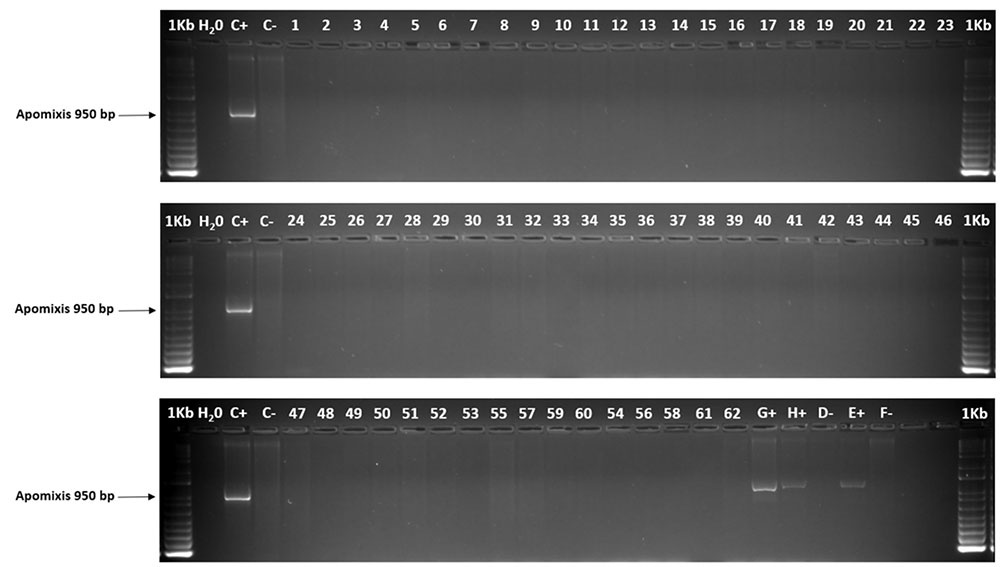
The objective of this study was to evaluate the molecular markers ASGR p779/p780, specific for aposporic apomixis, in the determination of the type of reproduction in accessions of Cenchrus purpureus. The study was conducted at the Alliance of Bioversity International and the International Center for Tropical Agriculture. The samples under study come from 62 accessions of C. purpureus from the Germplasm Bank of Grasses and Forages of Instituto de Ciencia Animal. The type of reproduction of the accessions was determined by Polymerase Chain Reaction (PCR) with the combination of direct and reverse primers p779/p780 completely linked to the aposporic apomixis. It was not obtained DNA amplification from the C. purpureus accessions and the Urochloa spp. controls that were negative for aposporic apomixis. However, DNA amplification was obtained from positive controls to aposporic apomixis in Urochloa spp. accessions reported as apomictic. The amplification products revealed a well-defined polymorphic band on the gels with an approximate size of 950 base pairs. The p779/p780 primers amplified the apomixis-positive Urochloa accessions, but did not amplify the negative controls or the C. purpureus accessions. These results suggest that (I) or the 62 accessions of C. purpureus from ICA reproduce sexually and do not exhibit aposporic apomixis, or that (II) the primers are not specific to this species.
Article Details

This work is licensed under a Creative Commons Attribution-NonCommercial 4.0 International License.
Those authors that have publications with this journal accept the following terms:
1. They will retain their copyright and guarantee the journal the right of first publication of their work, which will be simultaneously subject to the License Creative Commons Attribution-NonCommercial 4.0 International (CC BY-NC 4.0) that allows third parties to share the work whenever its author is indicated and its first publication this journal. Under this license the author will be free of:
- Share — copy and redistribute the material in any medium or format
- Adapt — remix, transform, and build upon the material
- The licensor cannot revoke these freedoms as long as you follow the license terms.
Under the following terms:
- Attribution — You must give appropriate credit, provide a link to the license, and indicate if changes were made. You may do so in any reasonable manner, but not in any way that suggests the licensor endorses you or your use.
- NonCommercial — You may not use the material for commercial purposes.
- No additional restrictions — You may not apply legal terms or technological measures that legally restrict others from doing anything the license permits.
2. The authors may adopt other non-exclusive license agreements to distribute the published version of the work (e.g., deposit it in an institutional telematics file or publish it in a monographic volume) whenever the initial publication is indicated in this journal.
3. The authors are allowed and recommended disseminating their work through the Internet (e.g. in institutional telematics archives or on their website) before and during the submission process, which can produce interesting exchanges and increase the citations of the published work. (See the Effect of open access).
References
Akiyama, Y., Goel, S., Conner, J.A., Hanna, W.W., Yamada-Akiyama, H. & Ozias-Akins, P. 2011. Evolution of the apomixis transmitting chromosome in Pennisetum. BMC Evolutionary Biology, 11: 1-16, ISSN: 1471-2148. http://www.biomedcentral.com/1471-2148/11/289.
Cook, B.G., Pengelly, B.C., Schultze-Kraft, R., Taylor, M., Burkart, S., Cardoso Arango, J.A., González Guzmán, J.J., Cox, K., Jones, C. & Peters, M. 2020. Tropical Forages: An interactive selection tool. 2nd and Revised Edn. International Center for Tropical Agriculture (CIAT), Cali, Colombia and International Livestock Research Institute (ILRI), Nairobi, Kenya. www.tropicalforages.info.
da Costa Lima Moraes, A., Mollinari, M., Ferreira, R.C.U., Aono, A., de Castro Lara, L.A., Pessoa-Filho, M., Lima Barrios, S.C., Franco Garcia, A.A., Borges do Valle, C., Pereira de Souza, A. & Vigna, B.B.Z. 2023. Advances in genomic characterization of Urochloa humidicola: exploring polyploid in heritance and apomixis. Theoretical and Applied Genetics, 136(11): 238, ISSN: 1432-2242. https://doi.org/10.1101/2023.08.31.555743.
Genesys PGR. 2025. Available at: https://www.genesys-pgr.org/ [Consulted: July 15, 2025].
Goel, S., Chen, Z., Akiyama, Y., Conner, J. A., Basu, M., Gualtieri, G., Hanna, W.W. & Ozias-Akins, P. 2006. Comparative physical mapping of the apospory-specific genomic region in two apomictic grasses: Pennisetum squamulatum and Cenchrus ciliaris. Genetics, 173(1): 389-400, ISSN: 3049-7094. https://doi.org/10.1534/genetics.105.054429.
González, B. & Hanna, W.W. 1984. Morphological and fertility responses in isogenic triploid and hexaploid pearl millet x napiergrass hybrids. Journal of Heredity, 75(4): 317-318, ISSN: 1465-7333. http://jhered.oxfordjournals.org/.
Hanna, W.W. 1981. Method of reproduction in napiergrass and in the 3x and 6x alloploid hybrids with pearl millet. Crop Science, 21: 123-126, ISSN: 1435-0653. https://doi.org/10.2135/cropsci1981.0011183X002100010033x.
Kumar, S., Saxena, S., Rai, A., Radhakrishna, A. & Kaushal, P. 2019. Ecological, genetic, and reproductive features of Cenchrus species indicate evolutionary superiority of apomixis under environmental stresses. Ecological Indicators, 105: 126-136, ISSN: 1872-7034. https://doi.org/10.1016/j.ecolind.2019.05.036.
POWO. 2025. Plants of the World Online. Kew Royal Botanic Gardens. Available at: https://powo.science.kew.org/taxon/urn:lsid:ipni.org:names:77106033-1 [Consulted: July 15, 2025].
Risterucci, A., Grivet, L., N’Goran, Pieretti, J., Flament, M. & Lanaud, C. 2000. A high-density linkage map of Theobroma cacao L. Theoretical and Applied Genetics, 101: 948-955, ISSN: 0040-5752. https://doi.org/10.1007/s001220051566.
Santos, L., Ragalzi, C., Gesteira, G., Vilela, M., Raposo, A., Jank, L., Santos, M. & Môro, G. 2025. Performance of the molecular marker p779/p780 for classifying mode of reproduction and its association with agronomic traits in a guineagrass breeding program. Euphytica, 221(7): 113, ISSN: 1573-5060. https://doi.org/10.1007/s10681-025-03556-x.
Wessapak, P., Ngernsaengsaruay, C. & Duangjai, S. 2023. A taxonomic revision of Cenchrus L. (Poaceae) in Thailand, with lectotypification of Pennisetum macrostachyum Benth. PhytoKeys, 234: 1-33, ISSN: 1314-2003. https://doi.org/10.3897/phytokeys.234.106486.
Worthington, M., Ebina, M., Yamanaka, N., Heffelfinger, C., Quintero, C., Zapata, Y. P., Perez, J.G., Selvaraj, M., Ishitani, M., Duitama, J., de la Hoz, J.F., Rao, I., Dellaporta, S., Tohme, J. & Arango, J. 2019. Translocation of a parthenogenesis gene candidate to analternate carrier chromosome in apomictic Brachiaria humidicola. BMC genomics, 20(41): 1-18, ISSN: 1471-2164. https://doi.org/10.1186/s12864-018-5392-4.
Worthington, M., Heffelfinger, C., Bernal, D., Quintero, C., Zapata, Y.P., Perez, J.G., De Vega, J., Miles, J., Dellaporta, S. & Tohme, J. 2016. A parthenogenesis gene candidate and evidence for segmental allopolyploidy in apomictic Brachiaria decumbens. Genetics, 203(3): 1117-1132, ISSN: 3049-7094. https://doi.org/10.1534/genetics.116.190314.
Xu, Y., Jia, H., Tan, C., Wu, X., Deng, X. & Xu, Q. 2022. Apomixis: genetic basis and controlling genes. Horticulture Research, 9: 1-10, ISSN: 2052-7276. https://doi.org/10.1093/hr/uhac150.