Evaluation of cassava leaf meal in the Clarias gariepinus feeding
Article Sidebar
Main Article Content
Abstract
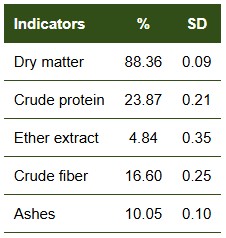
Different levels (0, 6, 9 and 12 %) of cassava leaf meal (variety CMC-40) were evaluated in the feeding of Clarias gariepinus small fish. A total of 180 animals with an average initial weight of 10.34 (0.08) g were randomly placed in twelve circular cement tanks with a capacity of 68 L. The experimental treatments consisted of four diets: the commercial catfish pre-fattening feed (control) and the remaining ones with 6, 9 and 12 % cassava leaf meal as a partial substitute for soybean and wheat. The experimental cassava leaf meal had 23.87 % crude protein and 16.60 % crude fiber. There were not differences between the amount of food (87.13, 85.57, 86.43 and 85.33 g) and protein supplied per animal (26.80, 26.57, 26.21 and 25.78 g). The growth rates (62.58, 61.31, 62.44 and 59.95 g of final average weight) and the feed conversion ratio (1.65, 1.68, 1.66 and 1.71) were not affected by either diet. Survival was 100 % for all treatments. Economic analysis showed that increasing the amount of cassava leaf meal reduced feeding and rations costs in all treatments. The greatest cost savings resulted from the inclusion of 9 % cassava leaf meal. It is concluded that the inclusion of up to 12 % cassava leaf meal does not compromise the productive performance of Clarias gariepinus small fish and has a positive economic impact.
Article Details

This work is licensed under a Creative Commons Attribution-NonCommercial 4.0 International License.
Those authors that have publications with this journal accept the following terms:
1. They will retain their copyright and guarantee the journal the right of first publication of their work, which will be simultaneously subject to the License Creative Commons Attribution-NonCommercial 4.0 International (CC BY-NC 4.0) that allows third parties to share the work whenever its author is indicated and its first publication this journal. Under this license the author will be free of:
- Share — copy and redistribute the material in any medium or format
- Adapt — remix, transform, and build upon the material
- The licensor cannot revoke these freedoms as long as you follow the license terms.
Under the following terms:
- Attribution — You must give appropriate credit, provide a link to the license, and indicate if changes were made. You may do so in any reasonable manner, but not in any way that suggests the licensor endorses you or your use.
- NonCommercial — You may not use the material for commercial purposes.
- No additional restrictions — You may not apply legal terms or technological measures that legally restrict others from doing anything the license permits.
2. The authors may adopt other non-exclusive license agreements to distribute the published version of the work (e.g., deposit it in an institutional telematics file or publish it in a monographic volume) whenever the initial publication is indicated in this journal.
3. The authors are allowed and recommended disseminating their work through the Internet (e.g. in institutional telematics archives or on their website) before and during the submission process, which can produce interesting exchanges and increase the citations of the published work. (See the Effect of open access).
References
Amare, T.A., Storebakken, T., Mørkøre, T., Nurfeta, A. & Ahlstrøm, O. 2024. Potency of cassava leaf as protein source for Nile tilapia (Oreochromis niloticus). Aquaculture International, 32: 10197-10214, ISSN: 1573-143X. https://doi.org/10.1007/s10499-024-01657-3.
AOAC 2016. Official methods of analysis of AOAC International. 20th ed., Rockville, MD: AOAC International, ISBN: 978-0-935584-87-5, Available at: http://www.directtextbook.com/isbn/9780935584875, [Consulted: September 22, 2016].
Ayoola, S.O. & Ogundele, D.C. 2018. Growth Performance of Clarias gariepinus Fed with Seaweed (Pistia stratiotes) Leaf Meal at Varying Inclusion Level. African Journal of Resources Management Fisheries and Aquatic, 3: 1-8, ISSN: 2672-4200. www.Theajfarm.com.
Blanquiceth, Y., Pérez, K., Tavera, M.J. & Salcedo, J.G. 2025. Caracterización de harinas derivadas de la parte aérea de dos variedades de yuca y su potencial aprovechamiento en alimentación animal. Ciencia y Tecnología Agropecuaria, 26(1): e3608, ISSN: 2500-5308. https://doi.org/10.21930/rcta.vol26_num1_art:3608.
Di Rienzo J A, Casanoves F, Balzarini M G, González L, Tablada M & Robledo C W 2012. Infostat versión 2012. Grupo Infostat. Universidad Nacional de Córdoba, Argentina. Available at: http://www.infostat.com.ar. [Consulted: October 09, 2019].
Díaz, P. & López, C. 2021. Yuca: Pan y Carne, Una Alternativa Potencial para Hacer Frente al Hambre Oculta. Acta Biológica Colombiana, 26(2): 235-246, ISSN: 1900-1649. https://doi.org/10.15446/abc.v26n2.84569.
Duncan, D.B. 1955. Multiple Range and Multiple F Tests. Biometrics, 11(1): 1-42, ISSN: 1541-0420. https://doi.org/10.2307/3001478.
Irabor, A.E., Obakanurhe, O., Pierre, J.H., Adeleke, H.L. & Chukwurah, I.A. 2023. Sweet potato (Ipomoea batatas) leaf meal as partial replacement for soyabean meal in catfish (Clarias gariepinus) juvenile diet. Livestock Research for Rural Development, 35(4): 31, ISSN: 0121-3784. http://www.Irrd.org/Irrd35/4/3531arno.html.
Kasihmuddin, S.M., Ghaffar, M.A. & Das, S.K. 2021. Rising temperature effects on growth and gastric empting time of freshwater African Catfish (Clarias gariepinus) fingerlings. Animals, 11(12): 3497, ISSN: 2076-2615. https://doi.org/10.3390/ani11123497.
Lancaster, P. A. & Brooks, J. E. 1983. Cassava leaves as human food. The New York Botanical Garden. Economic Botany. p. 341 -348.
Leguizamón, A.J., Rompato, K.M., Hoyos, R.E. & Audisio, M.C. 2021. Nutritional evaluation of three varieties of cassava leaves (Manihot esculenta Crantz) grown in formosa, Argentina. Journal of Food Composition and Analysis, 101(3): 103986, ISSN: 1096-0481. http://dx.doi.org/10.1016/j.jfca.2021.103986.
Levene, H. 1960. Robust tests for the equality of variance In: Olkin, I., Contributions to Probability and Statistics: Essays in Honor of Harold Hotelling, Stanford University Press, pp. 278-292, ISBN: 978-0-8047-0596-7.
Llanes, J. 2025. Evaluación de harina de yuca como sustituto del trigo en la alimentación de Clarias gariepinus. Tropical Aquaculture, 3(1): e5746, ISSN: 3061-7642. https://doi.org/10.19136/taa3n1.5746.
Llanes, J., Toledo, J. & Sarduy, L. 2016. Evaluación de la harina de moringa (Moringa oleífera Lam). Revista Cubana de Investigaciones Pesqueras, 33(1): 53 -58, ISSN: 0138-8452. http://hdl.handle.net/1834/10361.
Mukhtar, A., Latif, S., Barati, Z. & Müller, J. 2023. Valorization of Cassava By-Products: Cyanide Content and Quality Characteristics of Leaves and Peel. Applied Sciences, 13: 6340, ISSN: 2076-3417. https://doi.org/10.3390/app13106340.
Shapiro, S. & Wilk. M. 1965. An Analysis of Variance Test for Normality (Complete Samples). Biometrika, 52(3/4): 591-611, ISSN: 0006-3444. https://doi.org/10.2307/2333709.
Suárez, E.A., Mestra, L.I., Paternina, Y., Salcedo Carrascal, E.K., Luna C, L.L. & Vásquez, H.A. 2022. Yuca para la alimentación animal en la región Caribe: manejo, conservación y uso eficiente. Corporación Colombiana de Investigación Agropecuaria - AGROSAVIA. https://doi.org/10.21930/agrosavia.manual.740565.
Toledo, J., Llanes, J & Romero, C. 2015. Nutrición y alimentación de peces de aguas cálidas. Revista AcuaCUBA, 17(1): 5-22, ISSN: 1608-0467.
Tiamiyu, L.O., Okomoda, V.T. & Agbo, A.O. 2015. Nutritional Suitability of Leucaena Leaf Meal in the Diet of Clarias gariepinus. Journal FisheriesSciences.com, 9(1): 351-355, ISSN: 1307-234X. https://doi.org/10.3153/jfscom.201443.
Valdivié M 2022. Alternativas de alimentación para la producción animal en Cuba. Taller Producción de monogástricos. Memorias Convención Producción Animal y Agrodesarrollo. Del 10 al 14 de octubre 2022. Centro de Convenciones Plaza América. Varadero, Matanzas, Cuba. ISBN: 978-959-7171-86-7.